
Sources for Rancho Cordova Previous Residents
One address can have several histories. A deed shows a legal transfer. A directory shows a listed household. A census shows a household snapshot. A permit dates work. An obituary or probate file can close a person's trail and connect an estate to a property. The coverage table keeps those roles distinct while showing where the earlier-household evidence is held.
| Source | Years it covers | Where held | What it shows |
|---|---|---|---|
| Recorded-document index | 1849/1850-present | County Clerk/Recorder | Owners, parties, and chain citations |
| Deed images and books | 1850-present | Recorder counter or copy order | Transfer, legal description, execution and recording facts |
| Sacramento directories | 1850/1851-1982; microfilm 1860-1936 | CSH, Sacramento Room, State Library | Named residents, address, occupation |
| Haines suburban and criss-cross | Documented 1984-2018 | CSH and local collections | Address-to-listed-occupant browsing |
| Federal census | Through 1950 public | NARA and library databases | Household members, relationship, place |
| City and county permits | City era 2003-present; county earlier | Rancho Cordova or Sacramento County | Applicant, contractor, work, inspections |
| Aerials, maps, and plats | Varying; county map 1885 | LOC, Assessor, Recorder, archives | Physical development and subdivision context |
The coverage is deep because Sacramento County's land record reaches back to county formation, while the directory shelf follows the region's shift from early Sacramento to suburban Rancho Cordova.
Rancho Cordova Previous Residents Start With APN
Street labels can change, but the parcel and legal description often preserve continuity. Locate the address or APN in the County Assessor Parcel Viewer. Save the situs, APN, value, land use, parcel geometry, and recorder book/page reference. Then request the owner and tax-mailing fields through the Assessor lobby or a records request. The web viewer intentionally suppresses owner information.
The APN is the anchor for past-occupant research because it can connect today's parcel to a deed, subdivision map, permit, and tax record. It does not prove who lived there. A parcel may have one assessed owner and many unlisted household members. A tax mailing address can point away from the situs.
Keep the legal description with the address. A lot, block, map, or metes-and-bounds description can resolve a same-name parcel or old place label later.
A current APN is more durable than a memory of an old street label or postal city.
Rancho Cordova Previous Owners by Grantor
The deed-chain method moves from the current grantee to earlier grantors. Search the current owner or citation in the Recorder index. Order the acquisition deed. Read the grantor, then search that grantor as a prior grantee. Repeat until the index, legal description, or available image no longer supports the link. Grantor means the transferor. Grantee means the recipient.
- Locate the current APN and retrieve owner or book/page data through the Assessor route.
- Search the Recorder party index by name and year, then record document type and citation.
- Order the deed image or book page and copy the legal description, grantor, grantee, and recording facts.
- Search the seller as an earlier grantee, testing the same APN, map, and legal description.
- Stop or mark uncertainty when a legal description changes, a parcel splits, or a name match lacks place evidence.
The online index reaches to 1849, which is unusually useful for a community whose modern name came later. The deed image still comes through a paid order or counter route. A citation without the instrument is a lead, not the complete chain of title.
- Chain of title
- The sequence of recorded transfers used to connect one owner to an earlier owner.
- Legal description
- The title description that controls the land, such as a lot, block, map, or metes and bounds.
- Book/page
- A recorder citation used to locate a recorded instrument or map.
Rancho Cordova Previous Residents and Deeds
The Sacramento County recorded-document copy instructions separate the free party index from the image or certified copy. The county lists deeds, deeds of trust, reconveyances, assignments, liens, and other instruments. Current web fees list uncertified copies at $8 for the first page and $1 per additional page, certified copies at $9 for the first page and $1 per additional page, and self-service in-person uncertified copies at $1 per page.
Order by mail, fax, telephone, office visit, or the available copy route. Preserve the document number or book/page from the index. Military discharge records have statutory access limits, and sensitive identifiers may be redacted. The deed's legal description, not an assessment line alone, controls a title question.
The recorded-document copy instructions are useful when a previous residents search has reached the point where a citation must become an image.
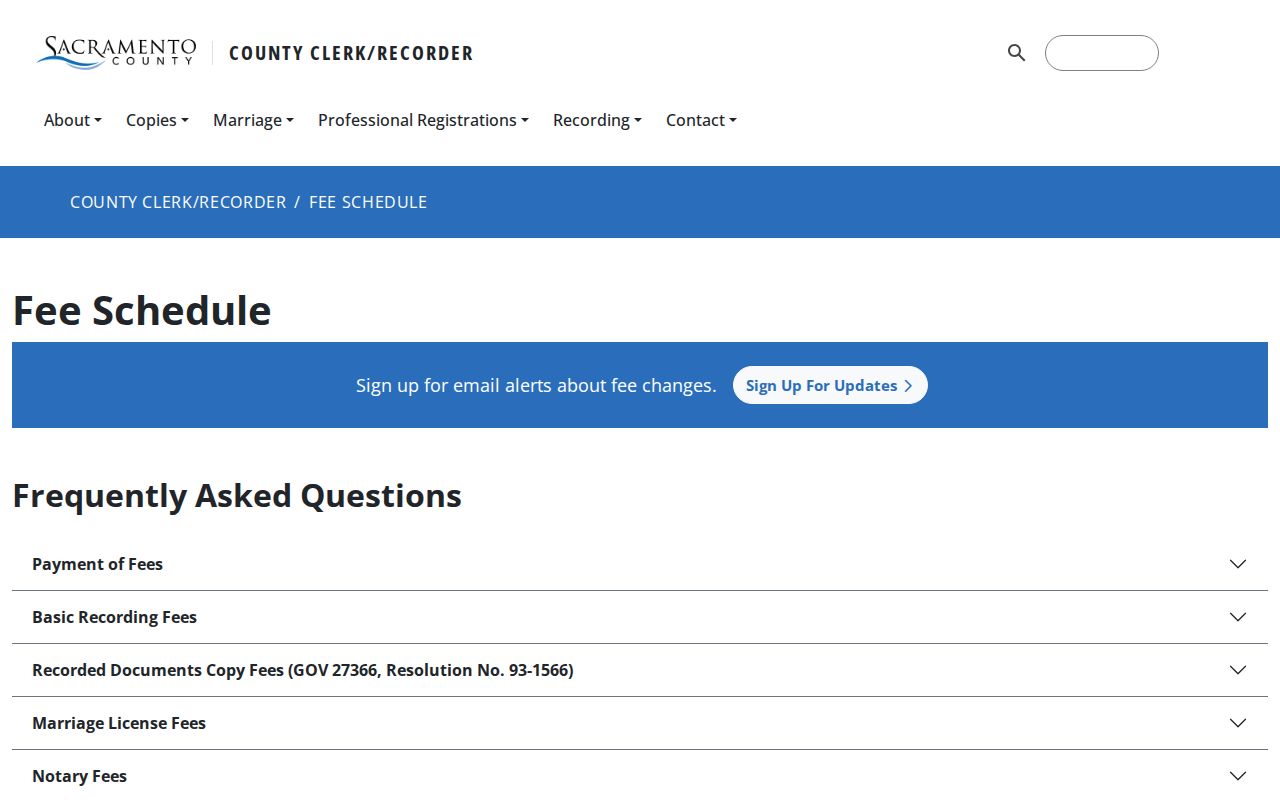
The copy route turns the party citation into the deed or other instrument needed for a chain of title.
The Recorder fee schedule is useful when an address-history search has reached the point where a citation must become an image.
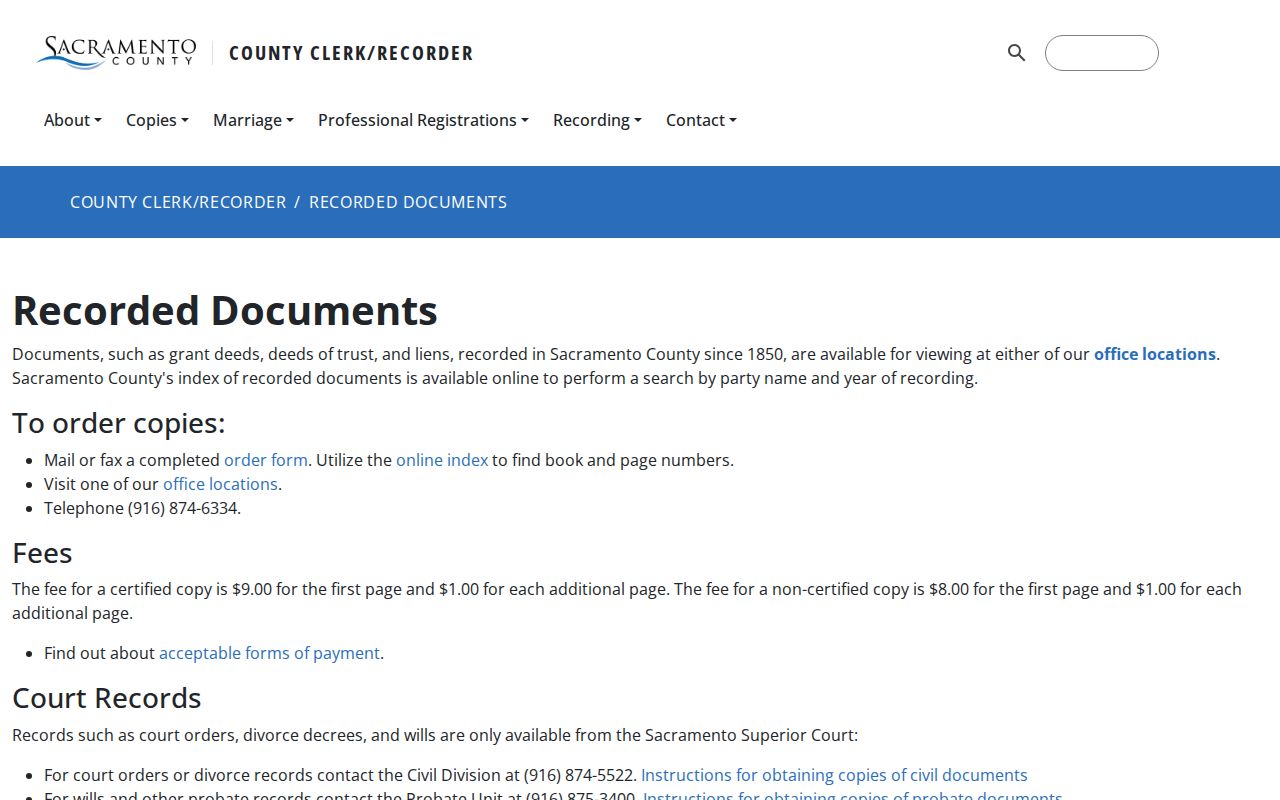
Keep the order details with the chain so a later researcher can retrace the same parcel and document.
A former owner may also leave a public business trail. The California Secretary of State bizfile search can supply an entity number, status, address, agent, and filing date for a business connection.
Use an entity record as an affiliation clue, then return to the parcel and deed before treating it as part of a house history.
Rancho Cordova Previous Residents Across 2003
Rancho Cordova incorporated July 1, 2003. A house history that crosses that line can have two permit custodians. Rancho Cordova holds city-era building, planning, code, and certificate-of-occupancy material. Sacramento County may hold earlier permits, land-use files, and inspection evidence. The address may also appear under Sacramento, Mills, Brighton, Mather, or a suburban postal description.
Rancho Cordova Online supports permit and plan applications, renewals, payments, uploads, inspection scheduling, and status or document review. A permit can show an applicant, contractor, work description, issue or final date, valuation, parcel, and inspection milestone. It dates construction or alteration. It does not date a resident's move.
For a pre-city request, name the old place label and the date range. A narrow request can ask for the address, APN, permit type, and inspection or certificate record without asking the agency to create a household history.
When a county-held file is not online, the Sacramento County records request portal supplies a public route for an existing electronic record.
A focused request should name the department, address or APN, record type, and date span so the custodian can search the right file.
Rancho Cordova Past Households in Directories
The historical city directory shelf supplies the household layer that a deed cannot. The Center for Sacramento History describes Sacramento-area city directories and telephone books from 1850 through 2019. Microfilm covers 1860 through 1936. Sacramento Directory Company and Polk volumes run through 1982. Haines suburban and criss-cross examples span 1984 through 2018. Search Sacramento city, county, suburban, telephone, and reverse products.
An alphabetical entry may give surname, given name, spouse, occupation, employer, and residence. A street section can begin with the address and list an occupant or telephone. “h” commonly means home, “r” room or residence, and “wid” widow in the cited directory form, but the publisher's key should be checked. Missing entries can reflect an omission, unlisted telephone, alternate spelling, or publication boundary.
The Rancho Cordova city directory collections page owns the collection detail. Previous residents work uses the volumes as dated address evidence, then tests the name against deeds, census, probate, or newspapers.
Pair Rancho Cordova Directories With Census
Federal census schedules provide a household snapshot through 1950, the newest year currently public under the 72-year rule. Pair a known directory address with the census when the geography and year align. Compare names, ages, relationships, occupation, and place. The census can show household members and relationships that a city directory compresses, while the directory can supply an address or occupation clue that makes the census search more focused.
Working sequence: directory entry → matching census year and address → deed, obituary, probate, newspaper, or permit check → dated house-history conclusion.
Do not treat a mismatch as proof of a move. Census enumeration, directory canvass, publication lag, and street descriptions can differ. Use a deed, obituary, probate file, newspaper, or permit to explain a change. For a post-1950 household, the directory, telephone, property, and vital trails carry more of the available evidence.
The historical collection's regional scope matters. Rancho Cordova was developing within a broader Sacramento setting, so a current city label is not the only valid search term.
Rancho Cordova Previous Residents and Heirs
Previous residents often leave a final trail through death evidence, an obituary, or probate. A newspaper notice can name relatives and former places. A probate petition can identify heirs, counsel, and property. A deed can show the transfer that followed. Use the obituary or memorial as a finding aid, then verify event facts with county or CDPH records and verify property with the Recorder.
Probate can connect a former owner to a family line, but it does not make every address or household detail public. Sealed or protected filings remain closed. An heir route should end at the official record that confirms the relationship or transfer, not at a guess based on a similar surname.
For a deceased owner, a careful order is death evidence, probate, deed, and then any directory or newspaper context. That sequence keeps the previous residents trail tied to a parcel and date.
Rancho Cordova Previous Address Names
Historic Rancho Cordova research has a place-name trap. An old directory or permit may use Mills, Brighton, Mather, Sacramento, or a suburban postal description rather than Rancho Cordova. A modern search that filters only the incorporated city can miss the earlier entry. Keep the address number and street, APN, subdivision, legal description, postal ZIP, and place label in separate notes.
The same address may also shift from county permit custody to city permit custody at incorporation. A parcel split can create a new address while the parent map or deed preserves the continuity. Use recorded maps, assessor parcel history, and deed legal descriptions to bridge the change.
No verified Rancho Cordova-wide street-renumbering year was found. Flag an individual rename through the deed, map, or planning record rather than inventing a citywide event.
Rancho Cordova House History Map Gaps
Sanborn fire-insurance coverage is not a verified complete map solution for Rancho Cordova. The Library of Congress has Folsom sheets from 1891 and historic Sacramento material, but no standalone Rancho Cordova Sanborn series was located. For suburban house history, use county maps, assessor maps, subdivision plats, aerials, recorded maps, and permits instead.
The Library of Congress HABS record for the Douglas Missile Test Facility or Alpha Test Complex adds a local aerospace and defense context, with named architects, companies, maps, and photographs. It can help explain an address or occupation clue, but it is not a household directory.
When a map ends, preserve the gap as a research note. A gap says what the collection did not show. It does not say that a previous resident did not exist.
Privacy for Rancho Cordova Previous Residents
Past household research still touches living people. The Safe at Home program offers substitute-address and confidential-voter protection for qualifying participants. DMV data is restricted. Utility customer details, protected addresses, sealed court files, adoption records, and private organization rosters stay outside a lawful previous residents trail. A directory can show a listed entry, not every person who occupied a parcel.
Commercial compilation services may combine old public material with inferred data and may merge same-name people. They are not authoritative. The source, date, page, deed citation, and uncertainty level should travel with every conclusion.
Lawful house history. Use prior-address records for genealogy, estate work, preservation, and personal history. Do not use a Rancho Cordova previous residents search to stalk, harass, intimidate, or harm anyone. Stop at a protected or sealed record.
A responsible house history can be detailed and still leave private household facts private. The record trail is strongest when it names what the source proves and what it cannot show.